Quick answer: Pressure washing and pressure cleaning usually describe the same broad category of exterior cleaning. Power washing is also commonly used as a synonym, although technically it can imply heated water. For most residential projects, the label matters less than the actual process: water pressure, gallons per minute, cleaning solution, nozzle, dwell time, surface-cleaner use and whether a soft-wash method is more appropriate.
Jacksonville context: Jacksonville homeowners will see contractors use pressure washing, power washing and pressure cleaning almost interchangeably. The wording matters less than whether the company chooses the right pressure, flow, chemistry and technique for the actual Northeast Florida surface. View Jacksonville service coverage.
The terms at a glance
| Term | Common meaning | What to ask instead |
|---|---|---|
| Pressure washing | Mechanical exterior cleaning using pressurized water, often with pretreatment chemistry | What pressure and equipment will be used on this surface? |
| Power washing | Often used interchangeably with pressure washing; technically may involve heated water | Are you actually using heated water, or is this just the service name? |
| Pressure cleaning | Broad service term common in Florida for pressure-washing work | Does the process include pretreatment, surface cleaning, edges and rinse? |
| Soft washing | Low-pressure chemical cleaning used on more delicate exterior surfaces | What solution, dwell time and rinse pressure will reach the surface? |
Why homeowners see all three phrases
Search behavior and local marketing have made “pressure washing,” “power washing” and “pressure cleaning” overlap heavily. A Jacksonville company may rank for all three while performing the same driveway-cleaning process. Another may call house washing “pressure washing” even though the siding is actually cleaned with low-pressure solution application and rinsing.
This is why choosing a contractor by terminology alone can be misleading. A service page titled “power washing” does not tell you whether a technician plans to use a surface cleaner on concrete, a downstream detergent system on siding or a dedicated soft-wash pump on a roof.
Pressure is only one part of cleaning
Water flow matters
Gallons per minute affect rinsing and production speed. More useful water flow can move loosened organic material and soil even when surface pressure is controlled.
Chemistry matters
Algae, mildew, oil, rust, irrigation staining and oxidation are different problems. The correct cleaning solution can reduce the amount of mechanical pressure needed and improve uniformity.
Nozzle and distance matter
The same machine can deliver very different impact depending on nozzle size, spray angle and distance from the surface. The machine’s maximum PSI rating does not mean that full pressure should be applied everywhere.
Surface cleaners matter on flatwork
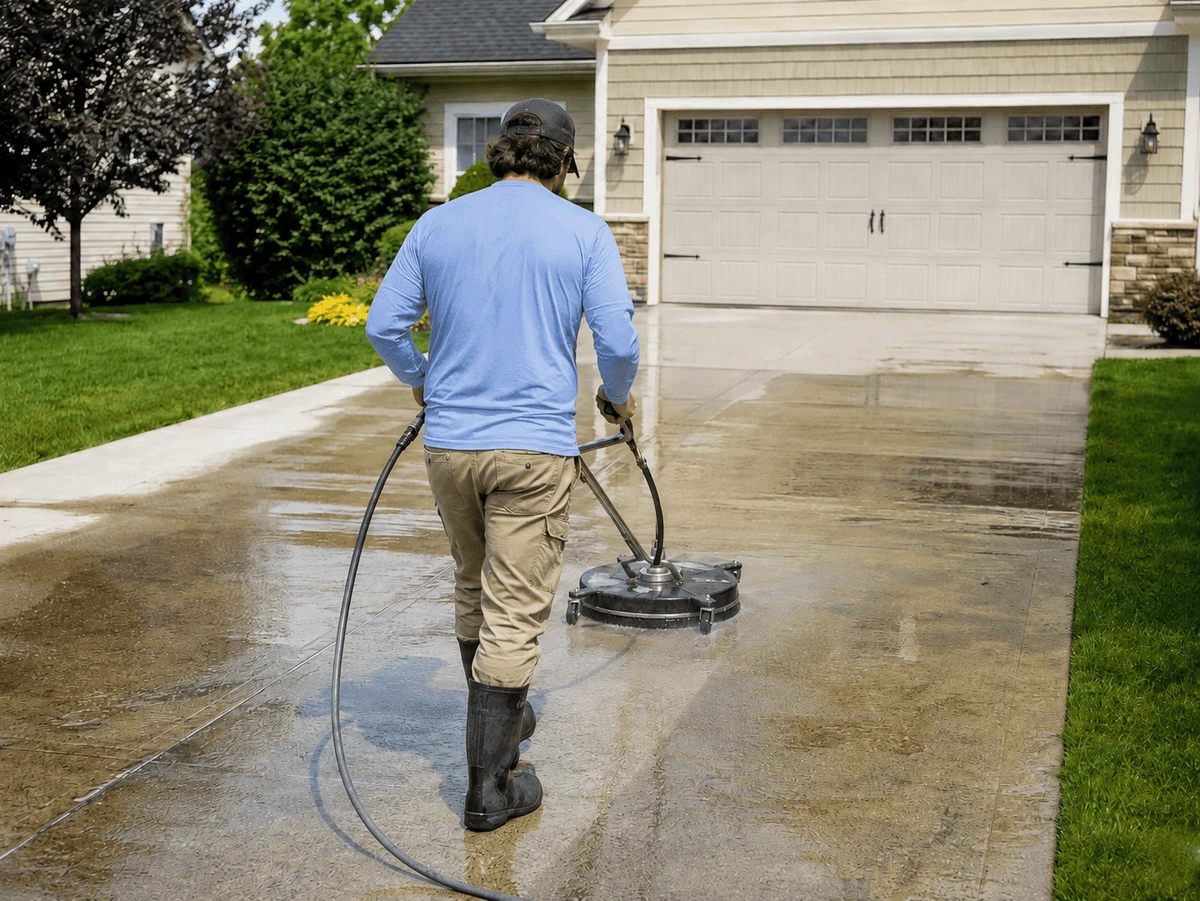
Professional driveway cleaning commonly uses a rotating surface cleaner for consistent passes across concrete, followed by edge work and rinsing. That is different from drawing stripes across a driveway with a wand.
Which method fits common Jacksonville surfaces?
| Surface | Typical approach | Main risk to avoid |
|---|---|---|
| Concrete driveway | Pretreatment + controlled pressure/surface cleaner + rinse | Striping, etching, missed edges, untreated specialty stains |
| Stucco house | Soft wash / low-pressure exterior cleaning | Water intrusion, paint damage, forcing water into openings |
| Vinyl or painted siding | Low pressure with appropriate cleaning solution | Oxidation disturbance, damaged seals, water behind siding |
| Asphalt-shingle roof | Roof-specific soft-wash treatment | Aggressive high pressure and granule damage |
| Pool cage / screens | Surface-appropriate low pressure and careful rinsing | Torn screens, damaged painted aluminum, pool contamination |
| Vinyl fence | Low-to-controlled pressure with cleaning solution | Damage to panels, oxidation or streaking |
When “power washing” actually means heated water
Hot-water pressure-washing systems exist and can be useful for certain grease-heavy commercial surfaces, industrial work and some specialty cleaning. Most standard residential house and driveway jobs do not require hot water simply because the customer searched for “power washing.”
If heat matters to the project, the contractor should be able to explain why. Otherwise, treat “power washing” as a marketing term and focus on the process.
Questions that matter more than terminology
- What exact method will you use on my house, roof and concrete?
- Will detergent or pretreatment be used?
- Will a surface cleaner be used on the driveway?
- What pressure reaches the siding or stucco?
- How do you handle oxidation, rust, oil or irrigation staining?
- What surfaces are excluded from the quote?
- How are plants, electrical fixtures, pool areas and painted finishes protected?
Simple rule: Hire the company that can clearly explain the process for your surfaces. Do not assume a company is safer or more professional because it uses one particular label.
Choose the method by surface risk, not by the service label
Concrete may tolerate a controlled mechanical cleaning process that would be inappropriate for painted siding, roofing or screens. A homeowner comparing quotes should ask what method reaches each surface, what pretreatment is used, how runoff is managed and which stains are considered specialty work. That comparison is more useful than assuming “power washing” is automatically stronger or better.
Related guides
- Soft Washing Vs Pressure Washing A House
- Can Pressure Washing Damage Concrete
- What Professional Pressure Washing Should Include
For a property-specific recommendation, request an exterior-cleaning estimate and include wide photos plus close-ups of the main concern.
Common questions
Is power washing better than pressure washing?
No. The term does not tell you whether the process is better. Surface compatibility, cleaning solution, water flow, pressure control and technician judgment matter more.
Does power washing always use hot water?
Technically the term can refer to heated water, but many residential companies and customers use “power washing” and “pressure washing” interchangeably.
What is pressure cleaning?
Pressure cleaning is a broad exterior-cleaning term commonly used in Florida. It can refer to driveway, sidewalk, building and other pressure-washing services.
Is soft washing safer than pressure washing?
For many roofs, stucco, siding and painted surfaces, soft washing can reduce the risk of damage from aggressive pressure. It still requires correct chemistry, concentration, dwell time and rinsing.